Part II - When Alcácer Went Dark
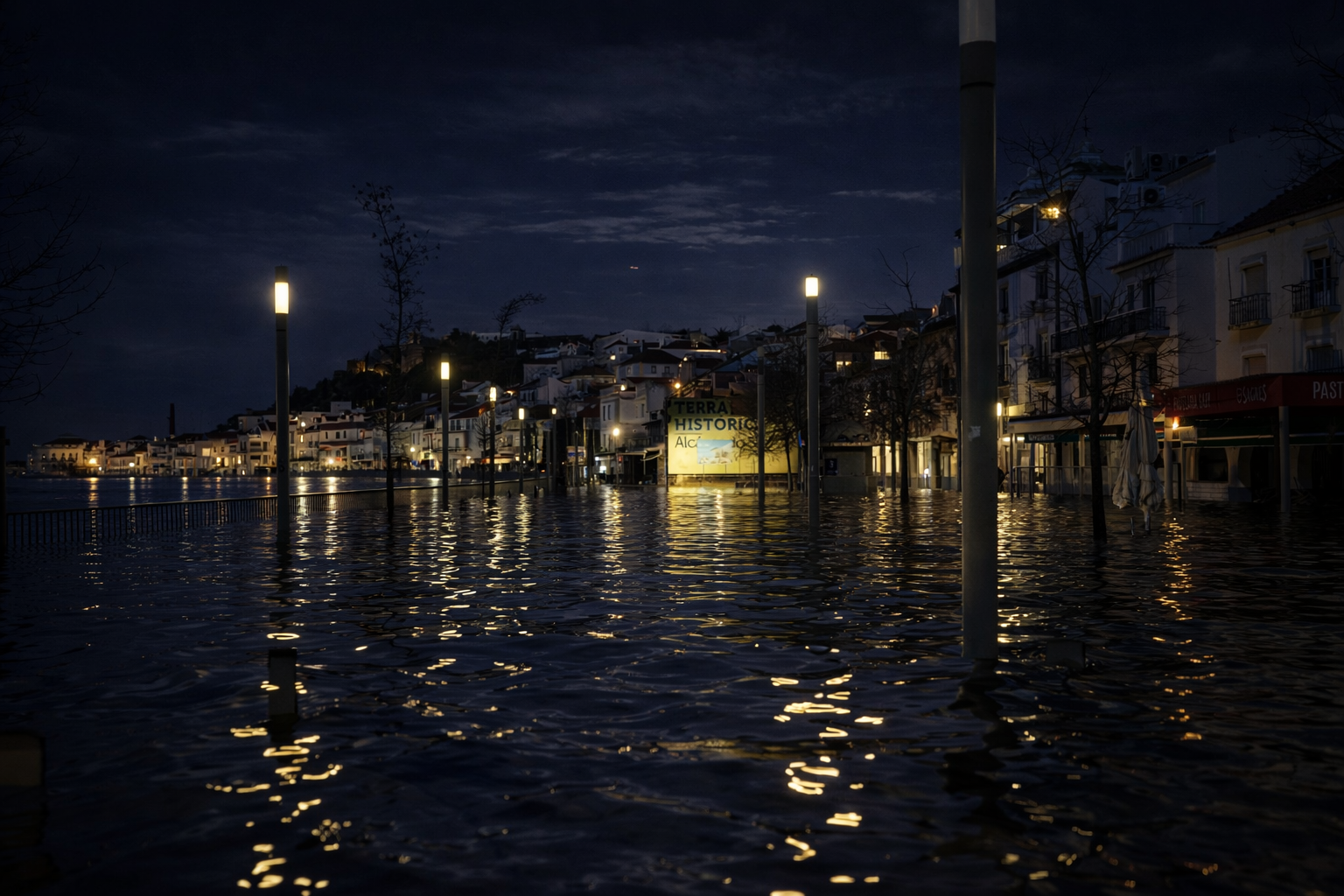
I turned around, left my building behind, and kept walking toward Social.
My small personal mission was over. The idea that I might still get back inside, grab the essentials, and make it out again collapsed the moment I saw the street. The water had not gone down. It had risen even more. And it was still rising.
What struck me next was the atmosphere.
Throughout the day, even with the unease building, there had still been room for disbelief. For half-smiles. For that nervous humour people cling to when something still feels temporary, or at least manageable. That had disappeared completely. As I moved through the higher streets toward my friends, it was clear the town had changed tone. Faces were serious. People were moving quickly, carrying things, calling out to one another, running back and forth frantically. No one was laughing anymore.
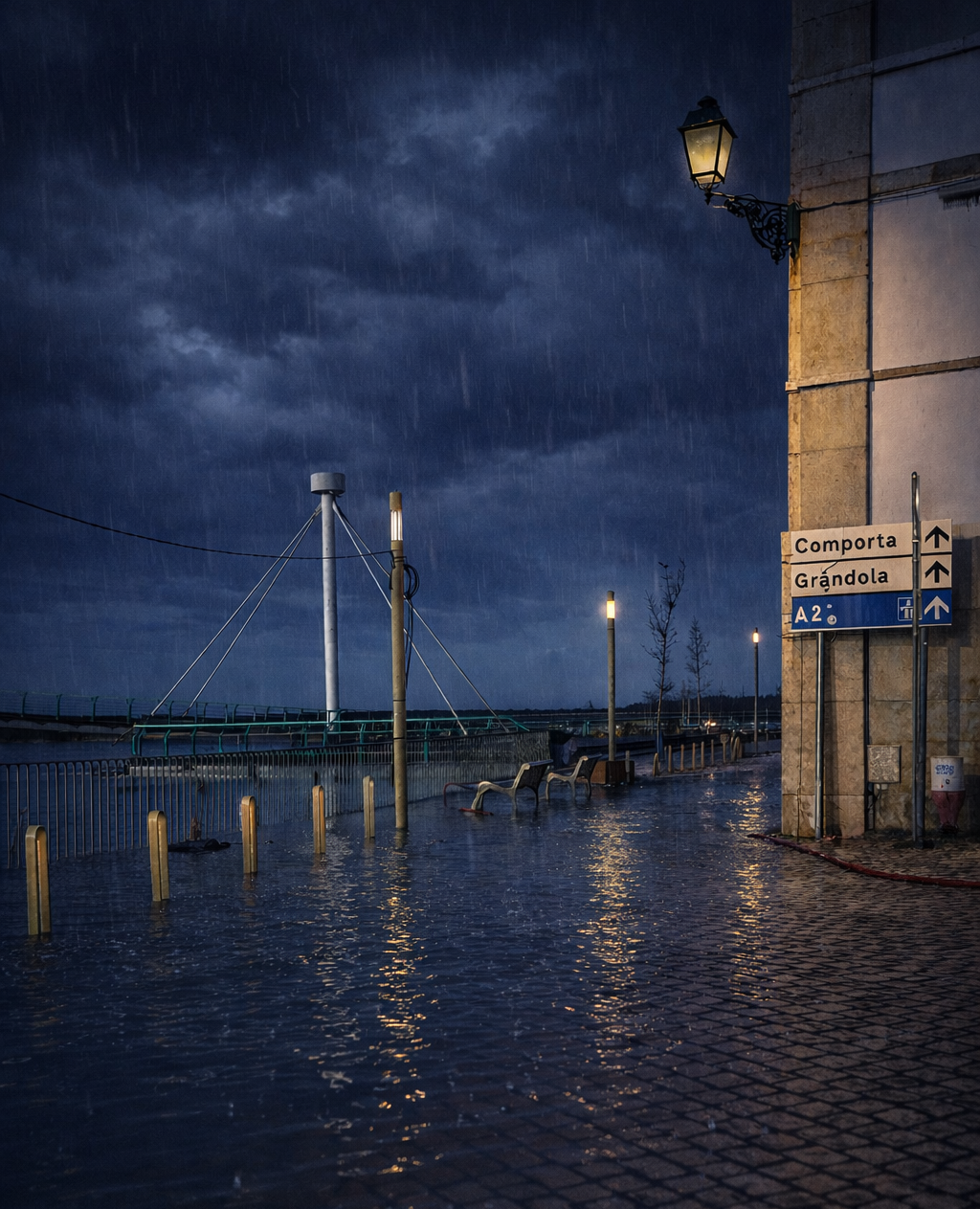
The rain persisted.
And so did the river, insisting on rising.
By the time I reached the others, the waterfront was already completely submerged. No one could even see, much less get close to, the front doors of the buildings facing the river. That whole line of houses and businesses had been cut off, as if the town had been silently redrawn while we were still trying to make sense of what was happening.
Everyone had gathered in the main street just above the central roundabout in downtown Alcácer, watching. Floods in Alcácer were nothing new, but this was something else. The water level had already gone beyond anything anyone there had ever seen. More than anything else, that was what gave the moment its strange quality. For a brief instant there was still that stunned awe that comes when what is happening in front of your eyes exceeds what you thought possible. We were still looking with that part of the mind that resists: on one side observing, on the other in complete denial.
But that feeling did not last long.
Homes, restaurants, pharmacies, businesses — all the places that lived off that stretch by the river, off the beauty of the Sado and the light that falls there at the end of the day — were now under water.
The emotional shift was brutal in its simplicity. First, astonishment. Then urgency. Then sadness. And immediately after that, something heavier. A kind of despair. A kind of mourning before anyone had even begun to count the cost.
You could hear crying in the streets.
Everything we had dismissed days earlier, or even minutes earlier, as exaggeration, turned into action. Since no one had ever seen anything like this, and nothing suggested it was about to stop, we began preparing for what only a few hours earlier had still seemed unthinkable. Or perhaps we were simply trying to prepare for the worst, if that is even possible once events have moved beyond your imagination.
At a certain point, without anyone needing to say it, it became obvious that this was not going to stop. And standing there with our arms at our sides, simply staring at the water in disbelief, became unbearable. The frustration grew precisely because there was nothing concrete we could do there, at that spot. And perhaps that, more than any plan, is what pushed us into what came next. We needed to act. Even if only a little. Even if only to avoid standing still while the water took hold of everything.
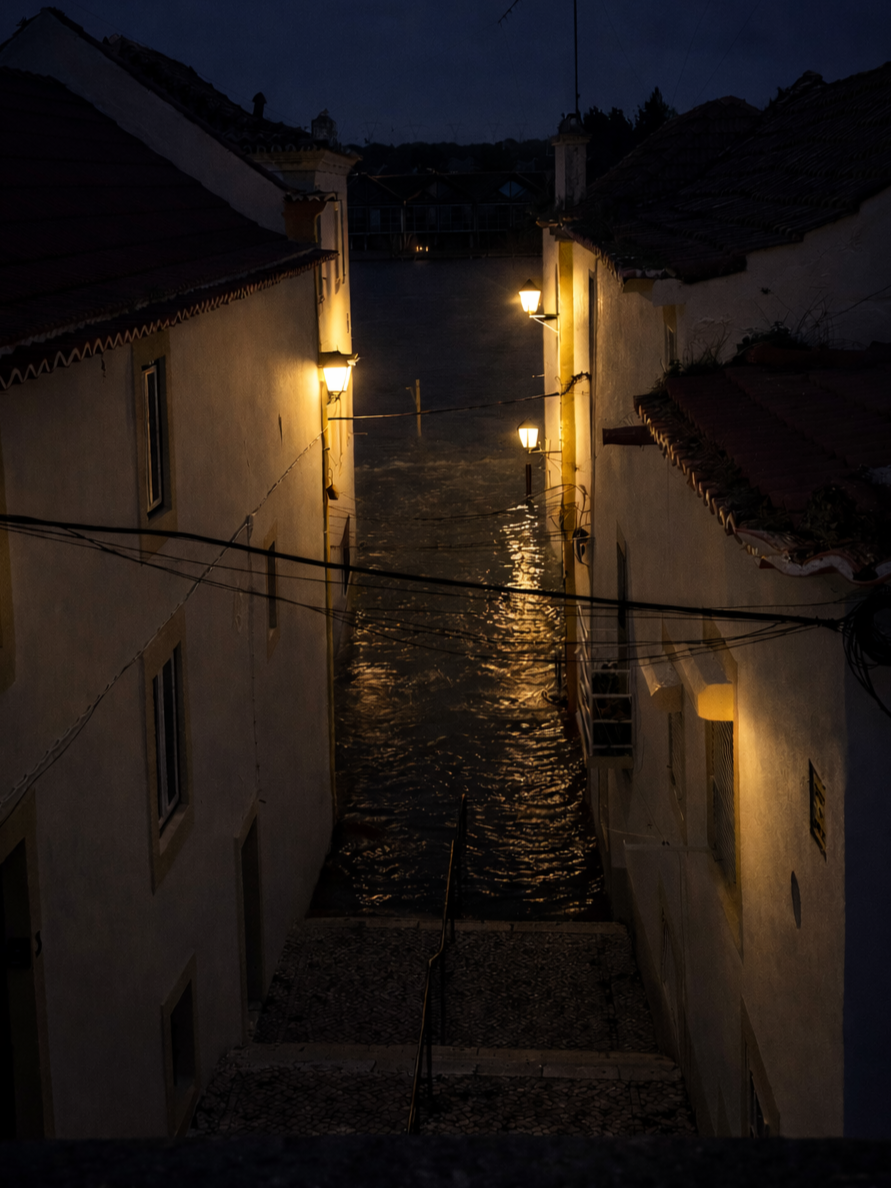
We decided to help Tio João prepare the warehouse he had in the street behind the waterfront, which he used as a support base for his two restaurants, both of which were already under water by then.
As we arrived at the warehouse, I noticed Tio João falling slightly behind. And that was when I saw him, almost as if the weight on his shoulders were growing heavier with every step, stop suddenly, sink down into a squat, and come apart.
Tio João is not a man I have ever known to stop easily. He is a hard worker, always moving, almost always smiling. Like me, he had chosen Alcácer as a place to rebuild his life. In the three years leading up to that day, he had worked tirelessly to build two restaurants that had become a vital part of life along the waterfront.
I was still processing everything myself, but I went straight to him, helped him back to his feet, and took him inside. I pulled up a chair and told him to sit. To breathe. To calm down. I wanted to tell him everything would be all right. But I could not. In that moment, I was not able to tell him something I myself was not sure of.
There was no wisdom in any of it. Only the instinct to help keep him standing while everything around us kept moving in the opposite direction.
To stop him from sinking any deeper into what was happening, we pushed ahead with reorganising the space. And also because, deep down, doing something was the only way we had of not giving in to the same feeling ourselves. Encouraged by the fact that we had started, he wiped his tears, stood up, and went back to work. And that, more than diminishing him, only confirmed who he is. There was no weakness in that reaction. There was weight. There was loss. There was the shock of seeing years of effort being swallowed up right in front of him. And even so, he got back up. He started directing people, organising the room, deciding what should go where. I remember thinking that perhaps, without realising it, he was trying to do the same inside his own head.
We repositioned everything that could still be saved, moved things higher up, protected whatever had not yet been reached. There comes a point in situations like that when you stop thinking broadly. You no longer think in terms of streets, or damage, or consequences. You think in objects. This table. Those boxes. This machine. One more thing out of reach. One more thing that gained a few extra centimetres of safety. At the same time, only a few metres away, at the end of the street, we could see the water advancing, slowly but without hesitation, drawing nearer to the warehouse. It was not the kind of rise the eye could follow in real time. You noticed it another way. We kept marking references on the wall, on signs, on fixed points in the street. Every five minutes, every ten minutes, we looked again at the same places. That was how we knew it was still rising.
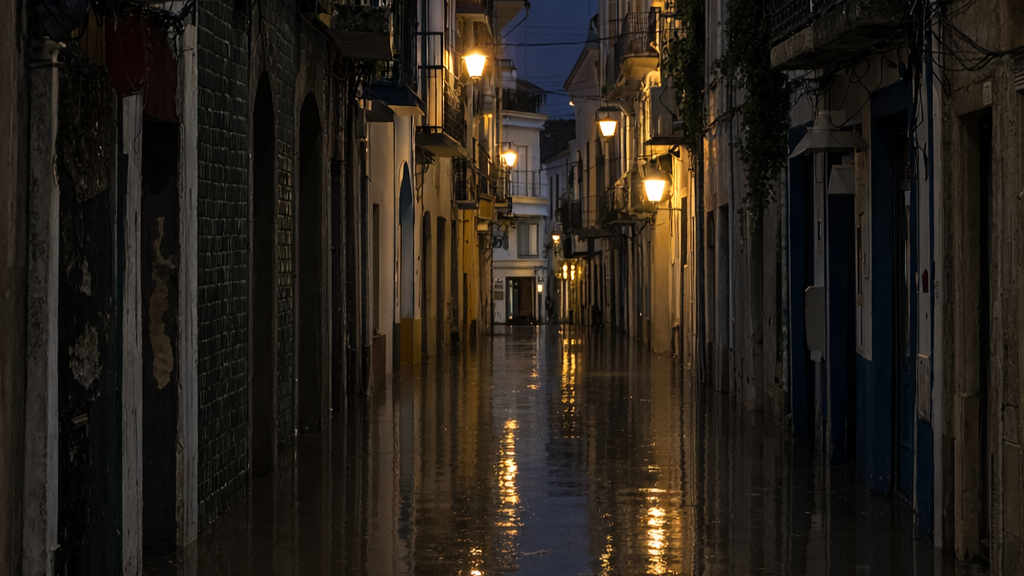
We did what was within our reach, because the rest was already too large to grasp all at once.
After a while, the pace slowed. Or maybe it only felt that way because we were running out of useful gestures. By then, the water had already reached unprecedented levels in Alcácer. Looking toward the waterfront, it was already possible to anticipate what that meant, even before the water went down enough to reveal the full extent of the damage.
Total loss.
By then, night had fully fallen.
There was not much more to do except stand there looking at the water and hope it might begin to recede, though by then even that hope felt fragile. We were exhausted, soaked, overwhelmed by what we were seeing, and no one was thinking clearly anymore. Then, suddenly, the town’s lights went out. Everything seemed suspended for a moment. There was a general jolt, a sudden apprehension, as if the worst might still be ahead. Some immediately feared the worst. Others began to speculate that the outage had been deliberate, a way of forcing people to prepare candles and alternative light sources for a blackout that now seemed unavoidable, though no one knew for how long. A few minutes later, the lights came back. But they came back differently: no longer as a sign of normality, only as a temporary reprieve.
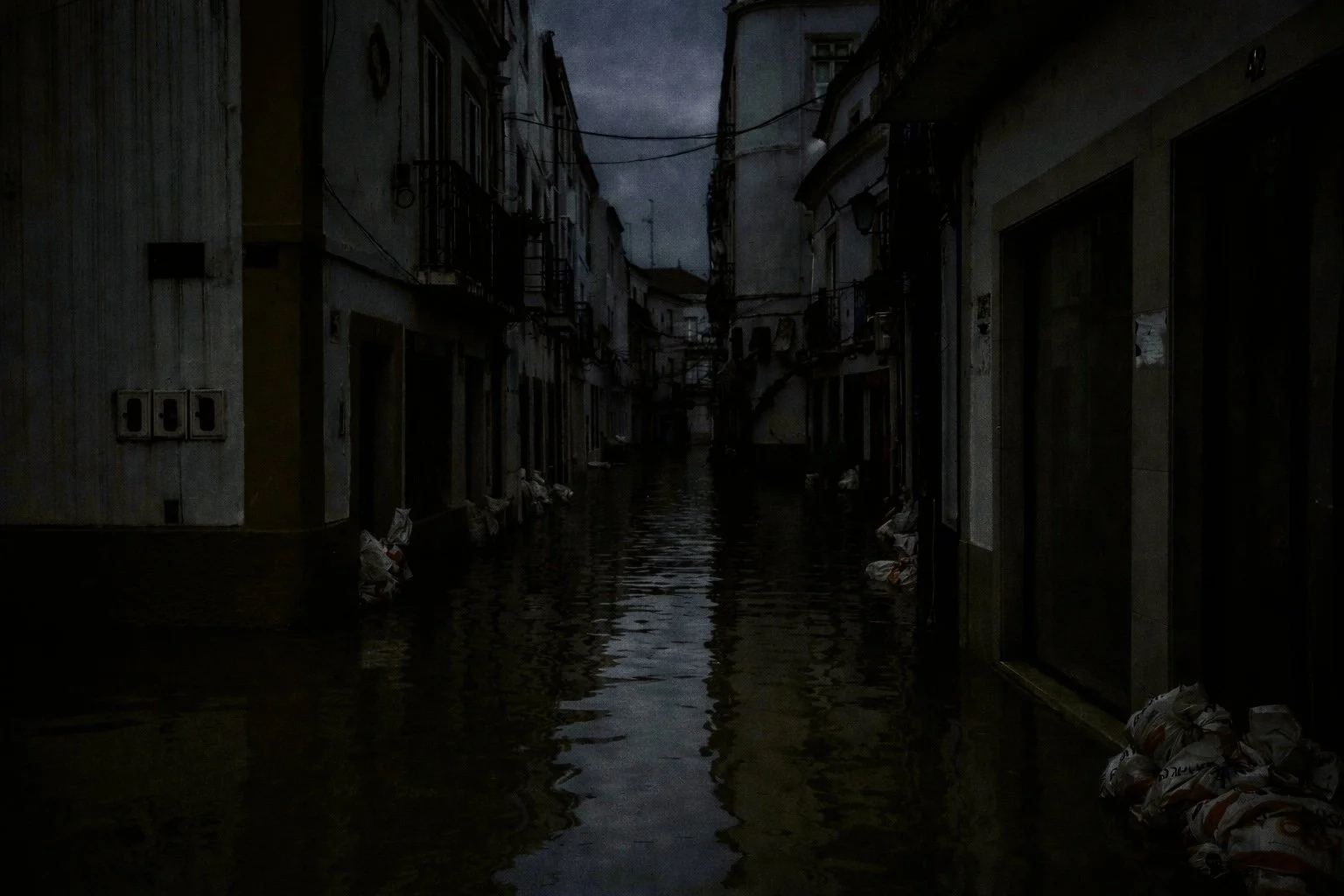
Not long after that, we decided to stop, at least for a moment, and go eat something hot. Not because anything had been resolved, and not because we felt entitled to a break, but because our bodies were giving way and we needed, if only briefly, warmth, food, and a chair beneath us.
Something normal in the middle of something that had nothing normal left in it.
Back at base, a heavy atmosphere met us. Or perhaps we were the ones bringing it into the room with us. Dinner was hot, ready. We sat down at the table and tried to give a name to what we had seen, but it was all still too recent, too raw, too unfinished. We spoke in fragments, circling around the same disbelief, testing words against a reality none of us had yet managed to absorb.
Out in the town, the water kept rising.
Around the table we talked about what might come next, or what might be done next, though there were no answers. There was still no plan. No organisation. No structure. There was only uncertainty and the growing awareness that by morning Alcácer would no longer be the same.
After a while, something shifted.
Maybe it was the food. Or maybe it was simply that when the body settles and regains strength, the will to return comes back with it. The plates slowly emptied, and with them part of that first paralysis seemed to lift. A refusal to accept defeat took hold. We got up almost abruptly, put our coats back on, and headed out the door again. Whether there was still something left to save, or whether we simply needed to be useful to someone, I could not have said for certain. We only knew that we had to go back.
When we returned to the roundabout, very little seemed to have changed at first glance. The water had risen a little more, but not much. Enough to raise a question, not confidence: maybe it was slowing down. Maybe it would not rise much further, at least for the moment. But no one accepted that possibility without scepticism. After what we had already seen, no one dared believe good news too quickly.
People stood in small groups, counting losses or unable to count them at all. The roundabout that had always been dry was now completely submerged. Women cried openly. Men held back tears. Others had already taken on that blank look of people who seem to have stopped inwardly, just to keep anything more from getting in.
And through it all, mobile phones kept ringing.
That sound stayed with me. Not loud enough to dominate the silence, but constant enough to keep tearing through it, in different tones depending on the distance at which it reached my ears. Beneath it was that deeper silence that had fallen over the town, interrupted only by the sound of water running over the roundabout and through the streets. And then, here and there, another phone cutting through that background. One more call. One more request. One more person asking what was happening somewhere else in town, or saying the water had reached them too.
Then one of those calls gave us something concrete to do.
A couple we knew, in another part of town, needed help removing and lifting whatever had not yet been reached by the water that had already entered their home. As a group, we went straight there and started lifting everything we could. Upstairs, as long as that was possible. Onto tables, shelves, and sofas when it was not. We stacked, moved, guessed. That was all anyone could do by then: imperfect estimates of how far the water might rise, and the hope that we were thinking a few centimetres above reality.
When we finally stopped and looked around, the living room had become something strange: an organised disorganisation, a Tetris of furniture, toys, and appliances. Outside, the downstairs patio had already disappeared under water. Inside the house, the water was beginning to creep slowly up the stairs. The flood was no longer a threat outside the door. It was already inside, coming in.
And yet the room was still recognisable as a living room. It was still clean. Still as orderly as circumstances allowed. Still clearly inhabited by a family with a real life inside it. But everything had been pushed upward and inward, gathered into corners and onto surfaces, in a desperate attempt to save whatever could still be saved. There was something both orderly and distressed in that image at the same time.
And what struck me, while we were handling those things together, was the intimacy of the gesture. We were not just moving furniture or objects. We were moving the private weight of someone’s life. The things that say little to anyone standing outside a house, but mean everything to the people inside it. The things loaded with memory, routine, affection, and the time lived there. I remember thinking of our own things, of how what matters most to one family might seem worthless to someone else, and yet be irreplaceable to us. The feeling was almost overwhelming. But in that moment there was no room to stay inside it. The only thing to do was to turn it into action and help as best we could.
That image stayed with me.
Soon after, just as people had begun to fear earlier, the city’s electrical grid started being shut down in different areas. It had to be. Water and electricity do not coexist without turning danger into disaster. One by one, the streets went dark. Whole sections of town were swallowed by blackout.
With the lights gone, the silence deepened.
It was unsettling in a way that is difficult to explain, except to someone who carries those streets inside them. Familiar places had lost not only their shape beneath the water, but their sound as well. The town seemed to fold in on itself. What only hours before had still felt noisy, reactive, chaotic, had now entered another phase altogether. Darker. Quieter. Heavier.
That was when we understood we had to stop.
Not because we wanted to, but because there was nothing sensible left to do in the dark. We had to try to rest, if rest was even possible. We had to wait for the morning light. We had to wait for the water, somehow, to give us some relief.
So we went home holding on to that same fragile hope: that by dawn the flood might finally have started to recede, and that with morning would also come the first true confrontation with reality. What had been lost. What might still be recovered. And beyond that, though it still seemed impossibly far away, the first thought of what would come after.
Rebuilding.
Going back to work.